
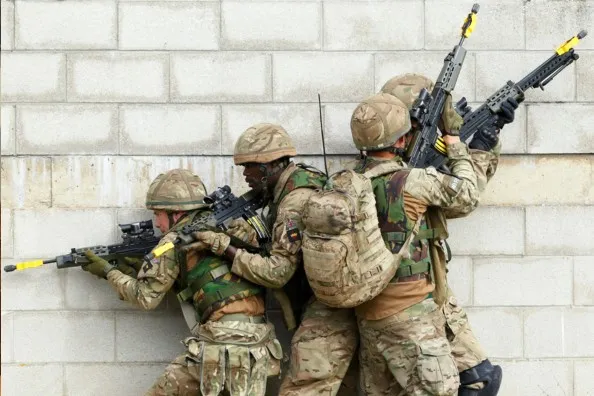
Britain’s armed forces have undergone a very long recessional. In 1945, the Army alone had some three million men under arms, with millions more in the navy, air force and various colonial forces. At the start of this year, by contrast, the “trained strength” total of the Royal Navy, RAF, Marines, and Army came to just 126,440, a figure that has actually fallen since Putin’s invasion of Ukraine. But it was not just that very low figure that explains John Healey’s dramatic resignation last week.
Read more Donald Trump knows how to party
Until relatively recently, British defense secretaries were much envied by their European counterparts — because they were allowed to conserve as much real combat strength as possible by cutting everything else to conserve money for training and realistic exercises, as well as the continuous maintenance it requires. Typical in that regard was Healey’s namesake Denis, a fiery socialist and decorated beachmaster at Anzio, who served as Labour’s defense secretary from 1964-70. No relation to his 21st-century successor, this elder Healey worked closely with his cabinet colleagues to cut costs on buying warships, aircraft, bases and the like, to focus instead on what really matters: training, munitions and maintenance.
That may seem like mere common sense. But since the post-Cold War drawdown that was underway by 1991, almost every European defense ministry has wasted increasing proportions of their diminishing defense spending to keep increasingly empty bases open — often just to preserve civilian janitors and ground-keepers in a job, and retired NCOs in their attached housing. Also bloated are the officer corps of most European forces, increasingly disproportionate to their shrinking personnel totals. The Spanish army is perhaps the leading champion here. Despite shrinking from 280,000 men in 1990 to just 75,000 today, it has preserved every formation command, and every regional headquarters and geographic command, including one for the Canary Islands, headed by a three-star army general and flanked by navy and air force counterparts.
Altogether, these commands absorb a remarkable percentage of the total armed force personnel: all just to keep up appearances, and jobs for generals and admirals. Nor is the Spanish army unique in this self-sabotage; Madrid’s wasted defense spending, which may even reflect the policy preferences of its pacifist government, is merely an exaggerated version of knowingly wasteful policies across Europe. By a remarkable coincidence, for instance, every branch of the Italian armed forces — as well as the civilian police, the customs police, and the carabinieri military police present in every town — buy almost all of their pistols, rifles and machine guns from privately owned Beretta. The French are arguably even worse offenders: all their combat aircraft are slated to come from the privately-owned Dassault Aviation, and for all the lobbying of British firms they are not allowed to become monopolies.
The root cause of John Healey’s complaint is that to preserve those envied British defense practices, to retain a disciplined focus in using taxpayers’ money to buy actually usable combat capabilities, there are minimum funding levels which must be respected. All concerned know perfectly well that spending on “combat readiness” is like buying cut flowers: which must be bought anew each day, at the expense of furniture that can last for decades or even centuries. In other words, doing defense for real is, much more than anything else a government does, like running a restaurant open 24 hours a day, 365 days a year. This is true even when compared with health care, in which the vast majority of patients do not require round-the-clock intensive care.
The real thing, the upkeep of true combat capabilities, has also required other forms of institutional discipline: including avoiding service in UN peacekeeping forces which never in fact carry out their mission to protect civilians if they have to use their weapons. The longest-lived such specimen, UNIFIL in Lebanon, has failed to execute its mission — of keeping Hezbollah from Israel’s border — even for a single day. Yet that has not prevented the participation of numerous Nato officers in over the years, including Lieutenant Colonel Thomas Karremans, the commander of the Dutch battalion meant to protect thousands of Bosnian Muslims gathered in the UN-declared “safe zone” of Srebrenica in July 1995.
We know how that turned out. Yet despite Karremans failing to follow orders and defend the enclave, ultimately allowing Serb fighters to kill some 8,000 men and boys, he was still promoted to full colonel upon returning to the Netherlands. Nato armies continue to retain a great many generals whose only “field” experience was in UNIFIL, to which the British Army formerly sent a single officer, and who was very soon withdrawn (it currently contributes exactly two personnel to the mission).
Read more The rise of Britain’s neo-Nazis
What have the British people ever obtained from their expensive “cut flowers” armed forces — that cost twice as much to operate as their European counterparts? Well, when asked to fight, they fight. A very recent example was the bombing of Houthi anti-ship missile and drone-storage sites in Southern Yemen by RAF Eurofighters. They flew out of Akrotiri, Britain’s sovereign base in Cyprus, despite being over 1,500 miles from Yemen in the Eastern Mediterranean.
When I asked the chief of another European air force — one that also flies Eurofighters — if his pilots could fly the same mission, he said “no” without a moment’s hesitation. To strike targets at those distances, he explained, you would need an aircraft with a sleep cot and a toilet; a cramped fighter cockpit is apparently not enough. And, in any case, you also need air-sea rescue continuously available along the way. Without it, he said, any flying mishap becomes a death sentence. That is also true of the RAF, of course, but its pilots crave the opportunity to fly real combat missions far too much to indulge their fears.
At the same time, British reluctance to get involved in the Ukraine war has not prevented SAS troopers from helping Zelensky’s government — officially just with training, but in practice with likely more. In sober strategic terms, there is nothing especially important about these examples. But think of the alternative: 3.5 million active Nato personnel, from Canada to Turkey, who eat breakfast, lunch and dinner in uniform every day — almost none of whom is ready to fight in earnest for any reason whatsoever.
John Healey’s predecessors could count on cabinet support to maintain the British difference, but things are now changing. Not only are many modern cabinet ministers in charge of ever-expanding social and healthcare spending — inevitable with an aging population — they are also increasingly attentive to Britain’s defense industry. The latter generally hates cut-flowers “combat readiness” spending just as much as any pacifist. Why? Because it takes many millions of pounds from their preferred weapon-system “programs”, which are comfortably long in duration, and which can last even longer if they are multinational in nature.
That is the case with the current British-Italian-Japanese jet-fighter project, which will keep many in stable employment — before its inevitable dissolution, when the British will defect to the American jet on offer once their bargaining chip becomes useless. The competing Franco-German fighter project has just died, after Berlin belatedly discovered that Dassault meant to control every part of the project, as befits the French Beretta of combat aviation.
Compared with all this, the first Healey had an easy time of it. The House of Commons was still full of war veterans, many of them working-class talents like himself, who entered the army as privates but soon rose through the ranks. They all knew what combat readiness meant, and were ready to defend it from industry as well as the social-welfare crowd. Evidently, the second Healey chose to resign to issue a wake-up call, because he could not obtain the funding needed to preserve a critical mass of competence in each branch of Britain’s Armed Forces. I well remember the day when my own regiment — the Oxfordshire and Buckinghamshire Light Infantry in which I learned to shoot, carefully, to make each bullet count — was amalgamated into the Green Jackets to preserve funds for “readiness”. If Healey’s sacrifice of his high ministerial position remains unheeded, unpleasant consequences will ensue sooner or later, as they always do.