
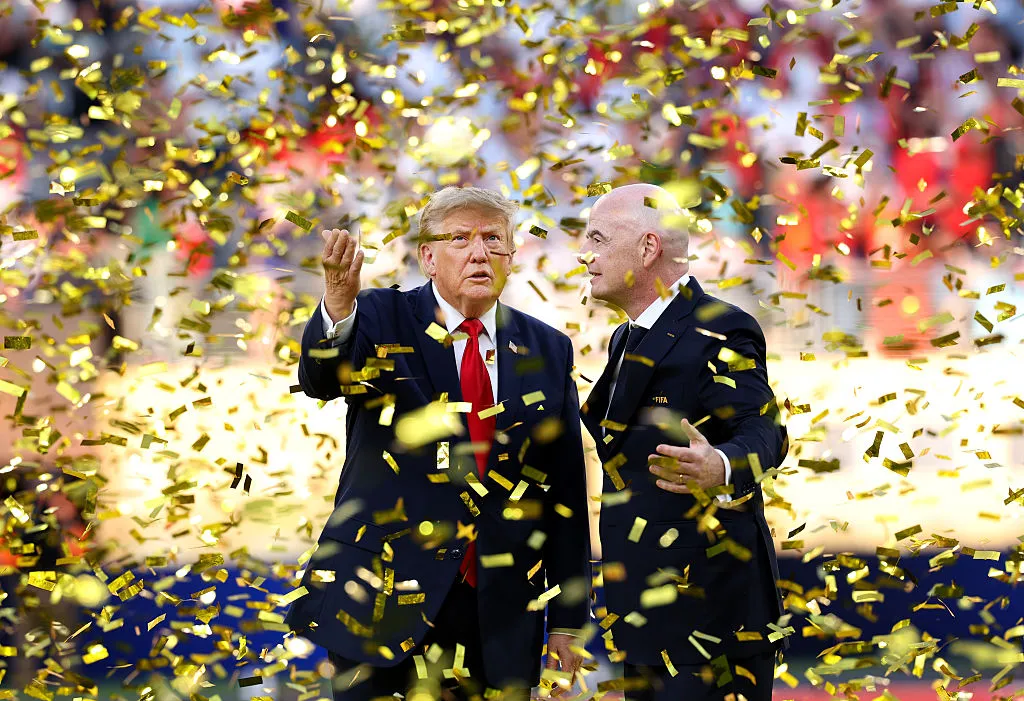
When does it end? When will football’s extraordinary growth stop? Will it ever cease to be the world’s most popular sport? There was a time when it would have seemed inconceivable to a Roman in the Circus Maximus that the world would not forever be gripped by chariot racing, but nothing is eternal. Perhaps, for football, this is it, not the end — but the beginning of the end.
Read more The abuse of a black teen’s death
There have been plenty of moments over the past few years when the goose that lays the golden eggs has been endangered by the people entrusted to look after it, with their odd combination of complaisance and avarice. But the game has perhaps never seemed more imperiled than it did on Tuesday when Fifa president Gianni Infantino announced his plans to sell off a stake in the World Cup.
The European governing body, Uefa, reacted with horror and issued a terse statement. “This crosses a line that football’s governing institutions should never cross,” it said. “None of us are the owners of football. It is not Fifa’s to sell.”
That conflict has come increasingly to the fore in the past two World Cups. There is a sense that each tournament has run on two parallel tracks: on the one side the outrages, the tolerance for human rights abuses, the naked lust for profit, the sycophancy towards autocratic leaders; and on the other the beauty and excitement of the football itself, the joy of fans, even as they’re squeezed for every last penny.
Uefa has been fighting a cold war with Fifa for at least a couple of years now as Infantino has stepped up his attempts to maximize revenues and to undermine Uefa’s control over the club game. So far, that has amounted to little more than gestures and trolling. Several presidents of European football federations walked out after Infantino arrived three hours late to last year’s Fifa Congress in Asuncion following a trip to Qatar with the US president Donald Trump; they subsequently released a statement criticizing Infantino for pursuing “private political interests”. When the Somalian referee Omar Artan was denied entry to the US before the World Cup, Uefa promptly appointed him to officiate at the European Super Cup final in August.
But this is far more serious. For the first time since 1966, when African sides demanding greater representation boycotted the World Cup, it feels there could be genuine mass action against football’s global governing body by its members. A schism is possible: perhaps the kind that has turned boxing or golf or cricket or chess into a mass of competing federations, rules and competitions. Until recently, this seemed unthinkable in football, which is, after all, a simple game based on legible traditions.
The brink was reached upon the announcement that Fifa has been working with JPMorgan to establish a new entity, Fifa Forward Enterprise, which would sell a 20% stake in the future commercial revenues of the men’s and women’s World Cups and the Club World Cup to investors. The move, it claims, will lead to an increase of “over $10 billion” in funds distributed to Fifa’s 211 members. Thrive Capital, an investment company founded by Joshua Kushner, the brother of Trump’s son-in-law, has been appointed to lead the search for investors.
Perhaps the choice of investment company shouldn’t come as that much of a surprise, given Infantino’s close relationship with Trump. Their love-in culminated in the President being awarded with the inaugural Fifa Peace Prize at the World Cup draw last December — which itself prompted the Norwegian football federation to join the human rights NGO FairSquare in complaining to Fifa’s ethics committee. Trump himself, with his supervillain’s habit of narrating his own malfeasance, seemed to suggest at a dinner in Davos in January 2021 that he and Infantino had somehow, even before he became president, to ensure that the USA, Canada and Mexico won the bid to host the 2026 World Cup.
But this new plan has surfaced a tension long-apparent in football: the governing bodies and lawmakers are also commercial entities aiming to make a profit. That apparent conflict of interest has been evident twice in the past year. First: in the gerrymandering of qualification criteria to ensure that Lionel Messi’s Inter Miami competed at the Club World Cup. Second: in the suspension, after only one game, of a three-match ban imposed on Cristiano Ronaldo, ensuring he could play in all of Portugal’s World Cup group games. Infantino’s Fifa was deemed to be prioritizing marketing concerns — getting the most famous players onto the pitch — over maintaining the integrity of the game.
A still more serious breach occurred when Fifa’s appeals panel seemingly yielded to three phone calls from Trump during the World Cup and suspended a red-card ban on the American striker Folarin Balogun. Uefa said that decision had “crossed a red line”. That’s two lines crossed in three weeks. Little wonder an emergency meeting of Uefa is set for today.
Fifa’s apologists have already argued that the Spanish league sold a 10.95% stake to private equity in 2021. But that argument is easily countered: a league is not a governing body. The sport in Spain is governed by the country’s Football Federation. Fifa, conversely, is supposed to protect the interests of football worldwide. It’s supposed to be a neutral lawmaker. What it’s not supposed to be is in hock to its investors. Under Swiss law, indeed, it is technically a non-commercial organization. It has — and of course the term seems laughable in the context of modern sports governance and Trump — a moral responsibility.
Read more Will Zack Polanski ever grow up?
Even beyond ethical issues, it’s worth asking why. Why now? Why does Fifa need outside investment? What will its members gain from selling off a percentage of future revenues? The World Cup has just made a record $15 billion, double what it made in Qatar in 2022. What is it planning to do with the billions of investment? Fifa has suggested that as many as 1.5 billion people watched the final between Spain and Argentina. These figures are always open to question, but the audience in the US was up 129% on Qatar. Does the World Cup so desperately need more marketing today that it’s happy to sacrifice 20% of future revenue tomorrow?
Perhaps some association heads see benefits in taking the money now and leaving the reduced future revenues for their successors to worry about. Indeed, Uefa made the accusation explicitly, accusing Fifa’s leadership of “using our sport to enrich themselves and their friends”.
The letter that member associations received on Wednesday makes clear the calculation many will be making. The initial deal is worth $20 million per association: but any member association that signs up within the next seven weeks can apply for an additional $20 million payment. Fifa insists that the whole process is far more transparent than it was in Sepp Blatter’s day. But a one-off payout of $40 million is likely to be extremely persuasive, not least when no full public study has been done since November 2015, when it was revealed that 81% of Fifa member associations were inadequately audited.
Infantino arrived in 2016 promising to swill out the corruption from Fifa. And his efficiency program involved a drive to reduce the number and size of Fifa’s committees which — since the financially dubious João Havelange became president in 1974 — has been an easy way to reward supporters. Yet none of this stopped Fifa in 2024 from voting to increase the number of standing committees from seven to 35.
It’s not to imply anything corrupt to point out that, while Infantino will be reelected as president by acclamation next year, Fifa’s constitution prohibits him from standing for a fourth term in 2031. (Then again, many thought it prohibited him from standing again in 2027, but he managed to convince them that his first three years didn’t count as he replaced Blatter part-way through an electoral cycle.) Once he has ceased to be Fifa president, he will need a new job, and commissioner of the World Cup would be an extremely lucrative one.
Given Fifa’s one-member-one-vote policy, it’s likely Infantino’s plan will pass, though it’s at least intriguing that Concacaf, the North and Central American confederation, said it was “deeply concerned” with the scheme. Realistically, though, if there’s to be meaningful opposition, it’ll have to come from Europe. The Football Association may have expressed doubts at the plan, but the only realistic option available to Uefa is the nuclear one: a boycott of the World Cup or secession from Fifa.
Of course, that comes with enormous risk. But equally, a World Cup without teams like Spain, France or Germany — and their TV markets — is not a World Cup. As an alternative, meanwhile, Uefa could use the existing Nations League as a base, before offering guest places to the best non-European teams. Suddenly, that starts to look a lot more like a World Cup than whatever rump is left to Fifa. Meanwhile, the threat of major European clubs supporting Fifa is mitigated by the fact that the Champions League, an enormous driver of revenue, is run by an entity jointly owned by Uefa and European Football Clubs, a group representing more than 850 clubs across all 55 Uefa nations.
In the past half-century, Fifa has become increasingly bound up in scandal. Growing frustration led to the toppling of Blatter at the Baur au Lac Hotel in 2015. But the situation has not improved under Infantino, who increasingly governs by fiat. Tellingly, the latest proposal has not been discussed by any Fifa body.
So this could be the final straw: if Europe does not stand up to Infantino now, then when? Yet even if it does, the fallout could be apocalyptic.
Read more Lies Al Gore told me