
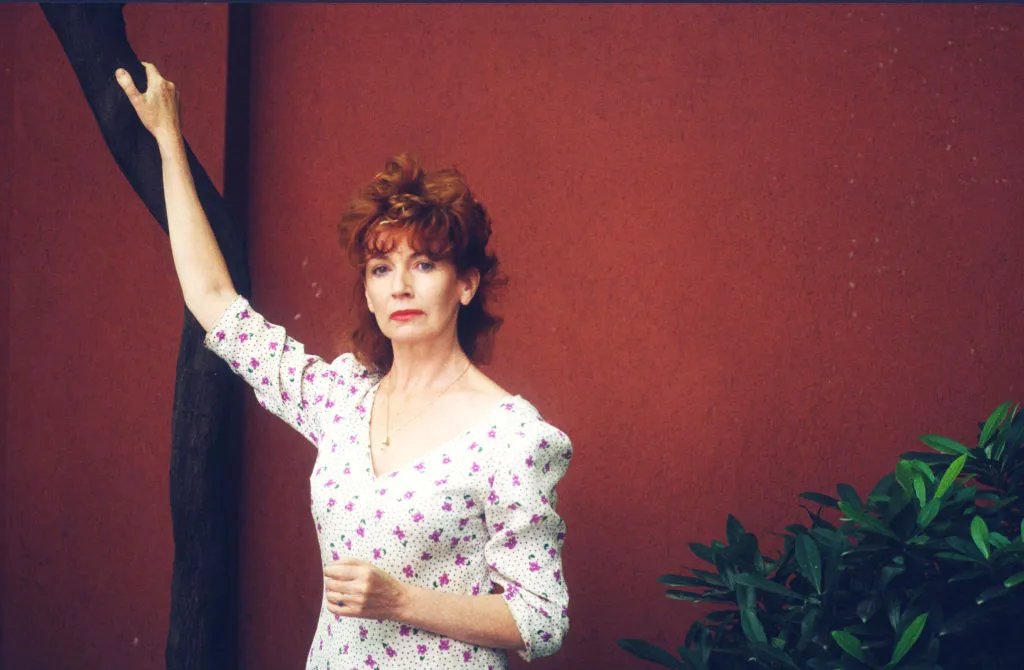
I had my first sight of Edna O’Brien on the stage of the Gate Theater in Dublin in the mid-Sixties. Censorship of books, plays and films was still vigorously applied in Ireland, and Edna’s own early novels, including her marvelous debut, The Country Girls, had been denounced by the Church and banned by the State. So notorious was her name that she had left Ireland and was living in London with her husband and fellow writer, Ernest Gébler.
The freshness and insouciance of her work shocked the elders of Érin, but the young were entranced. We had all read Lady Chatterley’s Lover and Molly Bloom’s soliloquy by torchlight under the bedclothes, but here was something new, a voice like our own saying in print the supposedly scandalous things we hardly dared to think. Yet the fact that hers were not what used to be called, with a snigger, “dirty books”, made them even more dangerous to the petty bigots who sought to control our lives, for in every page of her work, the prospect of freedom reared its handsome head.
The Sixties in Ireland were not as they were in America or the rest of Europe; we did not swing, or have summers of love, or let it all hang out — and if we had, it would have been summarily sliced off by a vigilante squad from the Legion of Mary. Yet there was a frisson in the air, and even an occasional direct poke in the eye of the powers-that-be; something was happening.
The event that Edna appeared in at the Gate was part of Project 67, a three-week series of politico-cultural “happenings” organized by a talented, colorful and courageous theater director, Jim Fitzgerald, and his friend Colm Ó Briain, who would go on to become one of the most influential figures in the arts in Ireland until his death in 2023. When Fitzgerald invited Edna to the inaugural gathering at the Gate, he urged her to bring some of her banned books with her, his intention being that they would be seized by Customs officials at Dublin Airport. Which they were, probably on a tip-off from Fitzgerald himself. The story got into the papers, of course, and provoked a splendid scandal.
I remember vividly the excitement of being in the audience that night. There were readings by actors from various banned books, fiery speeches were delivered, rhetorical fists were shaken at the Censorship Board and its shadowy controllers. In the midst of it all, center-stage, Edna sat, on a plain kitchen chair, wearing a demure outfit of pale jacket, dark skirt, court shoes and a string of pearls. I see her there, to this day, in my mind’s eye, with her magnificent red hair wound into a gleaming swirl about her head, uttering not a single word but gazing before her and smiling serenely, Yeats’s Pallas Athene come amongst us briefly, in all her poise and beauty; her presence alone was a glorious provocation.
“Pity you weren’t backstage afterwards,” an audience member luckier than I said to me next day, after Edna had returned to London. “That woman has a great store of filthy jokes.”
We missed her in Ireland. I told her so, years later, when at a party one evening we had a long talk about the old days. She would have been a figure for us to rally round, an Irish Marianne. “But how could I have stayed?” she asked, in a rich contralto wail. “They would spit at me in my own village, and my poor mother hardly dared let me into the house. I was a pariah. I had to get out.”
I used to see her now and then, in London, but also on her rare visits to Dublin. I loved her high style, her sense of fun, her scurrilous humor. Above all, I admired her self-possession.
One day she and I were taken to lunch in Dublin on some pretext by the Arts Council. We went to the Shelbourne, which in those days was the place to be seen. As we were crossing the dining room to “her” table — “They keep it for me in case I might drop in, bless them” — I spotted at another table the playwright Arthur Miller lunching with his daughter Rebecca and her husband Daniel Day-Lewis. Edna, of course, swept past them without a glance. We seated ourselves, and while the Arts Council folk and I began an earnest perusal of the half-meter-high menu, Edna beckoned to a waiter, addressed him by his first name, and said: “I’ll have a piece of fish and a nice glass of white, not too cold.”
Thinking she had not noticed them, I mentioned to her in a whisper the presence in our midst of a theatrical legend and his legendary son-in-law. She paused a moment, then turned on me slowly those great depthless eyes of hers, and said, “Oh, yes?” in a tone that let me know, in no uncertain terms, that if the goddess Fama herself were to waft into the room at this moment, the first person she would approach would be the author of a clutch of highly acclaimed novels, a biographer of James Joyce, friend of the likes of Philip Roth, Robert Mitchum and David Owen, and one of France’s Commandeurs de l’Ordre des Arts et des Lettres. So there.
Oh, but she was fun, and loved to poke fun, even, or especially, at herself. I am thinking of a reception in Paris years ago, given by the Académie Française for a large group of visiting Irish authors. It took place in one of the grander of the grands salons of the Institut de France, home of the Académie. My wife and Edna were talking together in a far corner, and at once point I noticed they were engaged in some sort of odd scuffle. I asked afterwards what had happened.
“We were talking away very pleasantly,” my wife said, “when Edna put a hand on my arm and whispered, “Oh, Janet, you’ll have to rescue me!”” What had happened was that her abundant tresses had got tangled in a metal light fixture projecting from the wall behind her. When she was freed, Edna took a restorative sip of champagne and said to my missus, “You know, everyone thinks that at my age this” — she shook her hair — “must be a wig, but at least now there’s one person in the world who can tell them it’s all my own.”
Speaking of champagne, Edna’s friend the Scots novelist Andrew O’Hagan tells of meeting her one day as she arrived back from a reception. The taxi rolled up, and Edna stepped out with her mouth set in the lines of a Greek tragic mask. “Oh, Andrew,” she breathed, “isn’t prosecco a curse!”
And then there’s Boston. It was in the Eighties, and there was a literary event at Harvard College, at which Colm Tóibín, Edna and I were scheduled to give a Saturday afternoon reading. The enormous lecture hall was full to bursting, but Colm and I had no illusions as to who among the three of us was the star attraction. Colm read first and was richly applauded. The audience was skittish — it was college, it was Saturday — and I thumbed through whatever novel of mine I was going to read from, and found a couple of what I judged to be the least gloomy passages. To my surprise, I elicited a few laughs from the crowd.
I finished, and took my seat in the front row, and after a well-judged pause Edna stepped up and positioned herself at the podium, looked down at me with a sweet smile, and murmured into the microphone, in her fruitiest County Clare lilt, “Oh, John, I wish I could be funny — like you”. The rafters rang with merriment, while I wished I could sink through the floor.
Edna and I were staying at the same Harvard hotel, and after the reading we met in the bar for a glass of wine. The art critic Robert Hughes happened to be in town also, and Edna would be giving him dinner here at the hotel that evening, and would I like to join them? I said certainly I would, since I had no other plans. “That’s grand, then,” Edna said, and went off to take a nap.
I sat on in the bar with a book, and presently noticed that Bob Hughes was there also, at a table not far from mine. He had been latched on to by one of those professional Irishmen-in-America, let’s call him Ruari — tweeds, brogues, voice as loud as his suit — whom I heard say to Hughes, as they were parting, that he would see him later, at seven o’clock. Odd, I thought, since seven was also the hour at which Edna, Bob and I were due to dine.
I was still in the bar when she came down at about 10 minutes to the hour. I mentioned the exchange between Hughes and the bold Ruari, who was standing at the bar now applying his schtick to some other visiting celebrity. She studied him for a moment with a narrowed eye, then instructed me to “go in and mind the table”, and she would deal with the matter.
I went to the dining room, found our place, ordered a “nice glass of white” à la Edna, and waited. After a minute or two she joined me, calm and queenly as ever.
“Well?” I asked.
“Well what, dear?”
“What about Ruari?”
She wrinkled her brow. “Ruari?”
“The chap in the bar I told you about, who was to meet Bob here at seven, for dinner.”
“Him? He’s gone.”
“But how did you get rid of him?’’
She sniffed, and gave an indifferent shrug.
“Oh, I told him to fuck off.”
We had a pleasant dinner, Edna, Bob and I. Hughes, I remember, was very proud of the tie he was wearing, the abstract design of which, when looked at from a certain angle, turned into a shapely, nude blonde. The shock of the bold.
Afterwards, Edna and I stayed on for a nightcap, reminisced for a while about the high times and low we had shared over the years, then called it a day. In the lift bringing us up to our rooms, Edna, in her Scarlett O’Hara mode, asked me what floor I was on, then sighed and added, “Not that it matters…”
The last time I saw her, we were in the Shelbourne again, having what we did not know would be our last glass of white together. She was as bright and mischievous as ever, though she confessed that she was much preoccupied with the prospect of death. Well, not with death, but rather with the arrangements for her funeral.
“Now, John,” she said, “in your books you’re always writing about these morbid matters, so I thought you’d be the person to consult. You see, I have a burial plot marked out for myself on a little island in a lake in County Clare. The thing is all arranged, and it’ll be a grand occasion. But here’s my worry.”
She paused for dramatic effect.
“I have,” she resumed, “an awful lot of relatives down there, you know, and they have an awful lot of children, which is lovely for them, and lovely for me, of course, but…” She paused again. “My worry is that all these young folk will turn up at the chapel with guitars and fiddles and tin whistles and all the rest of it, and start singing folk songs to send me on my way.” She was gazing at me soulfully. “How, would you say, I’d prevent that?”
I laughed, she laughed, we laughed.
“Edna,” I said, “you don’t need to worry. It will never happen.”
“Indeed? And why not, would you say, now?”
I see her sitting there opposite me, under the Shelbourne’s big bright windows, wide-eyed, mock-solemn, a merciless tease.
“Because, my dear,” I said, “you are among the immortals.”
And she is.