
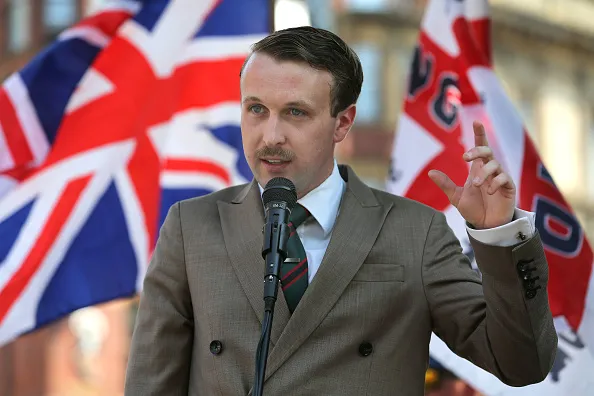
The first thing to understand about Alek Yerbury is that he is not trying to look like Adolf Hitler. He wears a leather overcoat similar to that which the Führer wore, but it’s just an overcoat. He has a small, sandy moustache and hair combed back across his head, but you cannot change your look just to win votes. And yes, Yerbury has described Hitler as his “hero” — but that, he says, is only because you have to recognise the competency of anyone who transformed their nation, Nazi or otherwise.
Read more Hartley, not Orwell, foresaw today’s tyranny
Yerbury, by his own account, is an “ethnocentric nationalist” and a third positionist. His economic views lie somewhere between capitalism and communism. He might also be called a fascist. Growing up in Australia, he returned to Britain, his parent’s homeland, and joined the army at 20 in 2015. Six years of service left him with an appreciation of military discipline and structure. Society, he thought, might be better organised along those lines than as a multi-party democracy. Collective will trumps liberal individualism.
Back on civvie street, Yerbury joined Patriotic Alternative, a hard-Right outfit led by another admirer of Hitler, Mark Collett, but came to believe it had no solutions to the nation’s problems and quit after about 15 months. He founded the National Support Detachment to back anti-migrant protests, but this also came to little.
In 2024, Yerbury registered the National Rebirth Party (NRP) with the Electoral Commission. It has high ambitions. Within 10 to 15 years, Yerbury told me, he expects to win national power. The Labour Party had taken longer to move from inception to victory, he acknowledged, but the scale of the crisis facing Britain is greater now. Progress seems slow so far, though. To date, the NRP has a little over 100 members.
The party is interested in addressing the causes of Britain’s demographic shift to a multiracial, multicultural society, rather than simply condemning immigration. Were its cadre to take power, they would establish a one-party state and deport as many non-whites as they could, while recognising that a 100% white Britain is likely a pipe dream.
“The aim,” Yerbury told me when we first spoke over the phone, “should be for the country to be as homogenous as possible.”
“If you’re running for election,” I suggested, “sort of the pitch to the public is: ‘Vote for us, and we’re gonna be in charge forever.’”
“Well,” he replied, “I would say the pitch is actually: vote for us for a genuine national rebirth.”
The first thing to understand about Alek Yerbury is that he is not trying to look like Adolf Hitler. He wears a leather overcoat similar to that which the Führer wore, but it’s just an overcoat. He has a small, sandy mustache and hair combed back across his head, but you cannot change your look just to win votes. And yes, Yerbury has described Hitler as his “hero” — but that, he says, is only because you have to recognize the competency of anyone who transformed their nation, Nazi or otherwise.
Yerbury, by his own account, is an “ethnocentric nationalist” and a third positionist. His economic views lie somewhere between capitalism and communism. He might also be called a fascist. Growing up in Australia, he returned to Britain, his parent’s homeland, and joined the army at 20 in 2015. Six years of service left him with an appreciation of military discipline and structure. Society, he thought, might be better organized along those lines than as a multi-party democracy. Collective will trumps liberal individualism.
Back on civvie street, Yerbury joined Patriotic Alternative, a hard-Right outfit led by another admirer of Hitler, Mark Collett, but came to believe it had no solutions to the nation’s problems and quit after about 15 months. He founded the National Support Detachment to back anti-migrant protests, but this also came to little.
In 2024, Yerbury registered the National Rebirth Party (NRP) with the Electoral Commission. It has high ambitions. Within 10 to 15 years, Yerbury told me, he expects to win national power. The Labour Party had taken longer to move from inception to victory, he acknowledged, but the scale of the crisis facing Britain is greater now. Progress seems slow so far, though. To date, the NRP has a little over 100 members.
The party is interested in addressing the causes of Britain’s demographic shift to a multiracial, multicultural society, rather than simply condemning immigration. Were its cadre to take power, they would establish a one-party state and deport as many non-whites as they could, while recognizing that a 100% white Britain is likely a pipe dream.
“The aim,” Yerbury told me when we first spoke over the phone, “should be for the country to be as homogenous as possible.”
“If you’re running for election,” I suggested, “sort of the pitch to the public is: ‘Vote for us, and we’re gonna be in charge forever.’”
“Well,” he replied, “I would say the pitch is actually: vote for us for a genuine national rebirth.”
***
A decade on from the murder of Jo Cox at the hands of the white supremacist Thomas Mair, a new generation of hardline neo-Nazis believe they are standing on the edge of a historic breakthrough. Following the Southport attack, asylum hotel protests and the murder of Henry Nowak, they see an opportunity to latch onto a large and dynamic movement. In their eyes, locals concerned about unvetted migrant men are ripe to be converted to a far more radical ideology.
Anti-migrant demonstrations, one particularly hardline activist told me, had achieved two things: expanding the social base for racial nationalism and normalizing violent, physical resistance to the state. “That sense of momentum,” they suggested, “is a powerful recruiting tool even if it’s chaotic.”
Over the past 10 years, meanwhile, Holocaust denial and explicit antisemitism have burst into the mainstream. The world’s most famous rapper wrote an ode to Hitler; young male streamers attack Jewish influence; the President of America dined with Nick Fuentes, an impish Shoah revisionist. “Six million cookies?” he asked in a 2019 video, comparing dead Jews to baked goods. “I’m not buying it.” Dark energies, once constrained by historical memory, have been let loose.
***
One day earlier this year, members of the National Rebirth Party gathered in Stafford to proselytize. It was raining heavily before I arrived, and the river had burst its banks, its brown water rising to engulf a line of benches. Yerbury and his followers were meeting in a former cinema, now a Wetherspoon’s pub, in the center of town. Under its arched ceiling, they ate fish and chips and discussed their plans.
These men provided something of a cross-section of British fascism. Daniel (who, like most of those present, would not provide his surname) was dressed like a football casual, in dark jeans and a thin jacket. As we spoke, he leaned towards me conspiratorially, his leg shaking underneath the table. He had dark circles below his eyes.
Daniel had grown up in a sectarian, Protestant community in the Black Country, he said, working as a manual laborer from the age of 16 before moving into white-collar management. His father was a Thatcherite, but his friend’s dad had introduced him to national socialism. Its sense of ideological rigidity appealed. “Asking for remigration is like giving someone painkillers because they broke their leg,” he said. What Britain needed, he argued, was to tackle the “international financiers” behind demographic change. When I suggested that was a euphemism, he laughed. “I don’t think Jews are the only problem. Anglo-merchants are an issue too.”
While Daniel seemed charged with a nervous excitement, George was more doleful. A heavyset young man with a silver nose ring and ear stud, wearing a dark suit, white shirt and red tie, he looked as if he might be a young Labour activist en route to party conference. It was only the small pin on his lapel bearing the NRP’s logo that revealed his true affiliation.
When he was nine or 10, George’s dad had walked out on him and his mum. He doesn’t know whether his father is alive or dead, and can remember little of him but flashed images of a bald man in a football shirt. He isn’t sure what his dad believed politically but, he thinks, he certainly looked like he was far-Right. For a while, George studied PPE at the Open University, but he dropped out after his mother developed a blood clot in her leg and was forced to have it amputated. Now, he serves as her carer.
He told me he had always been interested in the Second World War. But while he “took his hat off” to Britain’s fallen soldiers, he was not a fan of Winston Churchill. His heroes — in order — were “The Führer”, Julius Caesar, Oswald Mosley, and Benito Mussolini.
***
How closely to embrace Germany’s example has defined this country’s neo-Nazis since 1945. For all in the movement, Hitler is an inspiration. To some, out on the esoteric fringes, he is a pagan folk deity, or the reincarnation of a Hindu god. But in a country that went to war to defeat fascism, he can also be an embarrassment. It was a great mistake, National Front founder A.K. Chesterton once argued, for nationalists to be tied too closely to the “putrescent Nazi corpse”.
One man strapped closer to the corpse than most was Colin Jordan, whose undiluted vision of pan-national Aryan unity and undying commitment to paramilitary violence remains an inspiration for some. Born in Birmingham in 1923, he was first radicalized at Warwick School by Action, the house journal of the British Union of Fascists. During the war, he worked in a southeast London hospital, having been allowed to dodge military service because he supported a negotiated peace between Britain and Germany.
After the war, Jordan entered an extreme Right dominated by outlandish dilettantes. He joined a party led by the Duke of Bedford, who, according to Nancy Mitford, used to feed roast beef to his pet spider. He took intellectual inspiration from Arnold Leese, a world expert in Jew hatred and one-humped camels who avoided smoking and drinking with puritanical vigor. Writing in his autobiography, he claimed: “I think history records that England was at its best when it knew nothing of tobacco… and had no Jews.”
Across the Channel, Jordan developed ties with the alte kämpfer, or old fighters: former SS officers keen to mount a fascist resurgence. Then, after tumbling through a series of hardline groupuscules, he formed the National Socialist Movement (NSM) on 20 April 1961 — Hitler’s birthday. At the party’s Notting Hill headquarters, supporters were served a swastika cake. The NSM, which never had more than a few hundred members, was, according to a Met Police note at the time, composed of “converted fanatics” and “illiterate dupes”.
Later, the party held an international convention in a Gloucestershire woodland. Attendees, including American Nazi Party leader George Lincoln Rockwell and a former French SS officer, hailed Jordan as their “world Führer”. Seemingly oblivious to such a momentous development, angry villagers invaded the camp and captured its swastika flag, triggering police officers to move in and put a stop to the gathering.
Beneath this atmosphere of high camp stalked the threat of real violence. Searching the NSM offices later, the police found several tins of sodium chlorate, a weed killer that can be used as an explosive. Written on one were the words “Jew killer” and “place a few crystals in a sealed room full of Jews”. Convicted of breaching the public order act, Jordan was jailed for nine months.
Prosecuted alongside him was John Tyndall, who got six months. On most points, the two men agreed. Both venerated Hitler and both sought a white, Judenfrei Britain. But while Jordan believed in international white unity, Tyndall preferred an Anglo-Saxon Reich. And while Jordan emphasized an unbreaking commitment to paramilitary violence, Tyndall attempted to build a broader, mass movement as the leader first of the National Front and later the British National Party. Britain’s neo-Nazis have alternated between these two poles ever since: the violent cell versus the populist party; the street thugs of Combat 18 versus the besuited electioneering of the BNP. The NSM would eventually mutate into the British Movement, which still exists as one of the country’s most overtly neo-Nazi groups. (The party declined to comment for this article, telling me only that “racial consciousness” had begun growing in Britain long before the Southport attack.) Jordan himself stepped back from active politics in 1974, after he was caught stealing red knickers from Tesco. He had been, he later claimed, the victim of a Jewish plot.
***
After their fish and chips at Wetherspoons, the men of the NRP marched into a multi-story car park, got lost, and marched out again. Then they marched into town and set up a small gazebo on the high street. “If 500 people walk past and see that’s the same as giving out 500 leaflets,” Yerbury told me.
Read more The cult of Elon Musk
The rain began to pick up again and I walked underneath an overhanging shopfront with Alex Bramham, an affable, awkward man who grimaced as he smiled and seemed to alarm members of the public when he spoke. Lighting a cigarette, he told me that he had joined the NRP thanks to Yerbury. “He’s great to work with,” he said. “He’s very professional. His experience in the army shows. He’s put together a good foundation of policies and structure.”
Just a few years earlier, Bramham’s politics had been far more moderate. As recently as 2021, he was standing for election for the Social Democratic Party and writing about going to Pride celebrations for The Critic. His recent social media activity suggested a slide into darker territory. “Hitler was incredibly cool and championed many excellent policies,” read one post on X made last year. “The land of Shakespeare, Newton and Turner,” went another, “is now overrun by negroes and controlled by the Jew.” Sharing an advert for a chocolate-scented body spray, he wrote: “The racial undertones to this are real, sinister and controlled by the Jew.”
“I was looking at your tweets because you followed me,” I told him as he smoked. “I noticed you were tweeting about ‘the Jew’?”
“Uh, I won’t comment on that if it’s—” Bramham said, breaking off as he began to walk away from me, his cigarette butt in hand. “I’m just going for a bin there.”
“I’m just wondering because it’s something, obviously, you wanted to put that out there,” I said. “I’m not so familiar with the Jew?”
“I tweet things in a personal capacity,” he replied. “And I campaign in a political capacity. Sorry, I’m not trying to walk away from you,” he added, as he walked away. When he stopped, he insisted he would not discuss his views.
Then, finally alighting on a response, he said emphatically: “I strongly oppose usury.” And then he explained his views on usury. But he never told me why the Jew supports chocolate-scented body spray.
***
At the stall, NRP members milled around and handed out flyers detailing the party’s manifesto. In Yerbury’s United Kingdom, only people of British heritage would have the inherent right to citizenship. The Green Belt would be defended. The state would be controlled by a “strong national government with total authority”.
Is this what the public wants? For one bald man in a sheepskin jacket, the answer appeared to be yes. “I’m a gas engineer, so I travel to Nottingham, Derby, Wolves, everywhere, and I see the ruins of everywhere,” he said, as his son spun around a tree nearby. “Stafford’s a very unique place. We’re not overrun by immigration.” He unrolled a litany of complaints. Dossers were sacking off work by saying they had ADHD; women were having children to get benefits; gay people were pushing their lifestyle on children. Circling, the NRP cooed their agreement.
“It’s easy to identify the problem, but actually articulating an alternative is hard,” Yerbury told him.
“But the thing is, if you label me racist as soon as you bring it up, then it’s hard, isn’t it,” said the man. “And that’s what they do.”
“I’ll be straight,” replied Yerbury. “I don’t care if people call me racist. I’m comfortable with it.”
After he had left, I asked Yerbury if he thought the engineer would have taken a leaflet had he been open about his Nazi sympathies. For the NRP’s leader to assume that anyone who wanted to restrict mass migration was a latent fascist seemed to be the same error made by some on the Left. Yerbury insisted that his party neither officially liked nor disliked Hitler. “It’s an academic point,” he insisted, “that is actually politically irrelevant.”
***
For some of Yerbury’s fellow travelers, however, Hitler remains very relevant. Popping up at asylum hotel protests across Britain, White Vanguard, a neo-Nazi cell, have donned Helly Hansen jackets because the company’s logo, HH, might also stand for Heil Hitler. Posing for a photo with British Movement activists last year, members of the group sieg heiled in unison.
Just as in the Sixties, Britain’s fascists today are forced to shoot for either mass appeal or sectarian purity. Mark Cotterill, the editor of Heritage and Destiny, a hardline magazine, told me he did not think the asylum hotel protests had provided the racial nationalist movement with opportunity for growth at all. They seemed too full of “druggies, football hooligans” and “Tommy Robinson-style civic nationalists”, he said. Since he had joined the National Front in 1977, the cause seemed to be at an all time low. The time for a large, radical political party may have passed, he said.
Yerbury, by contrast, appears to sincerely believe he can win democratic elections. But the distinction between these two strategies — vanguardism and mass politics — has always been blurred. Though Tyndall tried to win office through the National Front and the British National Party, he also venerated extremists and praised Manfred Roeder, a German neo-Nazi who carried out a bombing campaign against asylum seekers and Holocaust memorial sites. National Front activists regularly launched attacks against ethnic minorities and Left-wingers. And while Yerbury will not publicly call for violence, he has endorsed it online. Writing about Boris Johnson and his cabinet on YouTube in 2021, he asked: “Where’s Thomas Mair when you need him?”
***
When I emailed White Vanguard requesting an interview, they said they no longer spoke to journalists. “Look into Aryan Front,” they added. “They are more likely to engage and a bit more extreme than us.” Aryan Front, it transpired, are a lot more extreme. Made up of a hardcore of activists that split from White Vanguard last year, they advocate for a “racial holy war” against Jews and non-whites.
The splinter group follows not the political ideology of Nazism but the religion of Creativity, which preaches racial separatism and is associated with a string of violent hate crimes in America. Online, Aryan Front has promoted the idea that journalists, among other such regime stooges, should be slain en masse on the “Day Of The Rope”. So, when I emailed, I was surprised to receive a polite response.
“I didn’t arrive here through hatred,” their spokesman explained. “I arrived here through what I see as pattern recognition and self-interest.” The group aims not for power, they said, but to maintain loyalty between whites in preparation for the racial holy war they see as inevitable. “Survival, not governance, is the measure of success.”
It can be hard to take such beliefs seriously. White Vanguard appears to have just a few dozen members; Aryan Front demos attract a handful of people at most. It is difficult to imagine that anything much could be achieved with such numbers. Within the state, though, the fear is that some will turn instead to terror.
While MI5 say that Islamist extremism remains the primary threat to Britain, extreme Right-wing terror is a growing concern. According to a 2022 report by Parliament’s Intelligence and Security Committee, the risk of tech-savvy young men acting alone is on an “upward trajectory”. “Few belong to organized groups: they are difficult to identify and monitor,” it concluded. Since they tend to be highly individual and driven by personal grievances, it is challenging to identify how, why and when they may attack.
Dominic Murphy, who until recently ran the Metropolitan Police’s counter-terror squad, told me that he had spent his tenure concerned about unsophisticated, self-initiated terror attacks of any ideology. Over the past decade, however, the authorities had developed a growing concern about young people engaging in violent, Right-wing extremism. According to the Community Security Trust’s database, in the decade since Cox was killed, 16 extreme-Right terror plots have been foiled.
Thomas Mair’s attack was archetypal. A loner in the most total sense of the word, he’d developed hardline beliefs in isolation, ordering extremist reading material from America but shunning physical ties. “Tommy’s nowt to worry about,” his neighbors in Birstall, West Yorkshire were reported to have said of him. “He wouldn’t hurt a fly.” But inside his sparse, semi-detached home, he had built a library of Nazi literature as he fantasized about the white race being forced into a “long and very bloody struggle”.
Others move from the internet to real-world connection. Last year, three neo-Nazis were jailed at Sheffield Crown Court after stockpiling body armor and weapons, and plotting attacks against mosques and synagogues. Their leader, Brogan Stewart, had British Movement propaganda on his bedroom wall. He had attended a meeting of Yerbury’s National Support Detachment.
Many of those who have not yet given up on politics, meanwhile, have begun to gravitate towards Restore Britain, buoyed by its spokesman’s ethnic definition of British identity. Take, for instance, Chris Mitchell, a self-described “Nazi-Buddhist” and Holocaust denier who has delivered leaflets for the party in Great Yarmouth and been photographed with Rupert Lowe.
When Restore Britain allowed nationalists to join, “they jumped on board, and I can’t really blame them,” Cotterill told me. “If I could join a political party… I may well consider joining [Restore].”
That the National Front and the BNP were led by neo-Nazis put a cap on their vote share, even if their policies on immigration commanded wide support. For the UK electorate, veneration of Hitler remains a red line. But Lowe, who has no such background and who gives the impression more of an avuncular Tory squire than a jackbooted thug, presents a different proposition. Britain’s fascists hope that he will provide them with an electoral vehicle they can manipulate to their own advantage.
“If you want to be involved in electoral politics, the only party to join is Restore and the only man to follow is Rupert Lowe,” wrote Mark Collett on Telegram earlier this year. “To have a party led by an MP that is openly espousing an ethno-nationalist position is a reason to celebrate.”
Steve Laws, a remigration campaigner who has described Hitler as “misunderstood” and protested alongside White Vanguard, has also encouraged his followers to join Restore. “I would advise any of you not as damaging as myself to get in as branch officers, candidates etc,” he wrote on Telegram in February. “We can create a stronghold in that party and really hold some weight over the direction.”
When the NRP finished canvassing, they packed up their gazebo and retreated from the rain. Tom, a law student in a blue suit, expressed disdain at the small crowd Yerbury had managed to attract. He was local, he told me, and could have got 120 people to turn up if he’d tried.
We chatted about his beliefs, and he said he liked Zoomer Historian, a Nazi-apologist YouTuber, and Varg Vikernes, an iconic black metal musician who had murdered his bandmate and now promotes an esoteric, extreme belief system. Tom said there were some good sides to Hitler’s rule and downplayed the Holocaust, but he also said that he did not wish to be publicly labelled far-Right. He wanted a career, he said, maybe in government. He was playing the long game.
Read more The socialist conquest of the Democrats